Meet our Desire in the Archive commissioned artist!
12th October 2026
We’re delighted to announce our commissioned Desire in the Archive artist, Luke Rooney!
In collaboration with Phoenix Art Space, this opportunity will see Luke Rooney create an exhibtion in response to the subject of desire inspired by the items in the QHS Digital Archive. This exploration will culminate in a final exhibition celebrating the 50th Anniversary of the partial descriminalisation of Homosexuality in the UK. Taking place Summer 2027 in Phoenix Art Space Main Gallery.

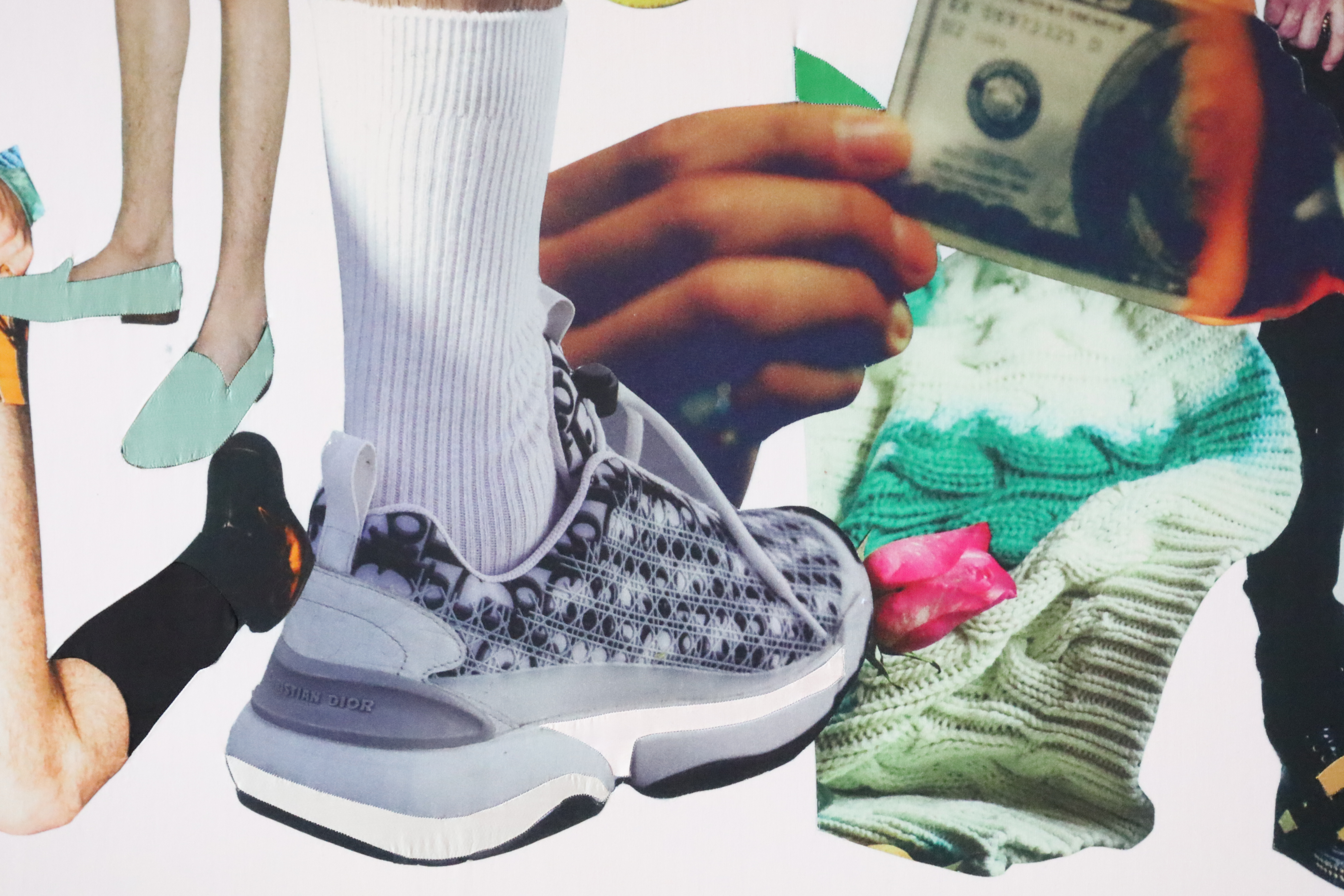
Luke Anthony Rooney is an interdisciplinary artist who works predominantly with collage and textiles. Luke’s practice lies within protest collage and reclaiming discourse associated with discrimination and challenging the identity of objects. With a background within the field of Fashion and Textiles, Luke had an eponymous design label, showing collections on schedule during London Fashion Week before merging his work into a Fine Art Textiles context. Luke was a selected artist for Bloomberg New Contemporaries 2023, Royal Academy Summer Exhibition 2026, with a presentation at London Craft Week 2024 Lukes latest fashion collection at London Fashion Week 2025 was a direct output of his research with the women of Gee’s Bend, Alabama.
Luke’s research is centred around how marginalised communities use textiles to communicate nonverbally through protest, semiotics and storytelling. This research has taken them across America to quilt with the women of Gees Bend in Alabama and Mississippi as well as exploring textiles and creativity on Native American reservations in Arizona, Colorado, Utah and in British Columbia, Canada. As well as an artist residency in Guatemala

Now that you know a little bit more behind Luke and his practice, we asked Luke for their thoughts and feelings as we work to produce the exhibition:
1) How does your work/process explore the tension between expressing LGBTQIA+ desires openly and the cultural, social and political pressures that necessitate maintaining ‘secret’ or ‘double’ lives?
My work expresses ideas of secrecy and doubling through coded visual language. Collage allows me to take an image apart, conceal elements and reconstruct them, while my textile process repeats this action through printing, cutting, stitching and intarsia. An image can therefore exist in more than one state: something may be visible while simultaneously being obscured. I am interested in how this material process can reflect the ways LGBTQIA+ people have historically navigated public and private versions of themselves, and the different ways this continues today. Clothing is also important within this. Coming from a fashion background, I am interested in dress as a form of self-fashioning: something that can communicate identity and desire openly, but can equally be used to conceal, protect or code it. Through this commission I want to explore the archive in a similar way, looking not only at what has been made visible and preserved, but also what remains outside the photograph, undocumented or deliberately hidden.
2) What are your artistic inspirations when it comes to Desire? Where do you find inspiration?
When it comes to desire, I approach it from several directions: the desire to belong, the desire for another person, place or identity, and even the desire for a time or experience that was never ours. Nostalgia therefore becomes a form of desire within my work. I am particularly interested in why we can feel emotionally attached to histories, places and images that we never personally experienced, and how nostalgia can cause us to romanticise or misremember the past. My inspiration often comes from human behaviour and the ways people construct identity and belonging. I am drawn to subcultures and the visual material surrounding them, magazines, photographs, clothing, music, domestic objects and nightlife, as well as conversations and experiences within communities. For this commission, I am interested in what happens when these personal sources of inspiration meet an actual queer archive, and how the histories I encounter might support, challenge or complicate my own imagined relationship with the past.
3) What are you most excited to achieve from this commission?
I am incredibly excited and honoured to receive this commission. One of the things I am most looking forward to is actively working with the Queer Heritage South archive and allowing that research to influence what the project becomes. Rather than approaching an archive simply as a collection of images to reproduce, I want to explore photographs, ephemera, objects, oral histories and also the gaps within the collection, using them as both material and points of departure for new work. I am also excited by the physical ambition the commission gives me. Visiting Phoenix Art Space made me realise the potential to work at a scale I have not previously been able to explore, particularly through monumental textile collages alongside more intimate quilts, fragments and installation. I want the commission to push my practice materially and spatially, while considering what we might contribute to the queer archive of the future.
4) What excites you about being part of an exhibition highlighting the 60th anniversary of the partial decriminalisation of homosexuality in the UK?
I am very conscious that the freedoms I experience today exist because of people who came before me, including people from older generations with whom I now have friendships. The people who marched, protested, created spaces and cared for one another are part of the history that stands behind my generation, but many of those same people continue to stand alongside and in front of us today. That connection between generations is very important to me. The 60th anniversary of partial decriminalisation provides an opportunity not simply to celebrate progress, but to consider how incomplete and uneven that progress has been. Queer history contains extraordinary resistance, creativity, community and joy, alongside criminalisation, loss and exclusion. Many LGBTQIA+ people continue to experience hostility, and there are fractures and inequalities within our own communities that also need to be acknowledged. I have always been interested in history because understanding where we have come from changes how we understand the present. Through this exhibition, I want to look backwards without romanticising the past, while asking what histories we are creating now and what we want to leave behind for future queer generations.
We're really excited to bringing Luke's work to Phoneix Arts Space next year!

Words from Phoenix Arts Space & Queer Heritage South:
"Luke’s response to the Desire in the Archive commission was thoughtful and thematically rich. I am fascinated by his work and process and excited to spend the coming months supporting him as he works towards his exhibition in the Main Gallery here."
- Laurence Hill, Curator, Phoenix Art Space
"As part of our series of exhibitions opening in 2027 and engaging with our archive, we were really keen to carve some space for the intangible. Desire is so often omitted and edited out of our social history when we enter institutional space, so working with Phoenix Art Space on this commission has felt like a very exciting opportunity as a project. We are looking forward to experiencing Luke’s exploration of our archive through large scale and tactile art, nostalgia, and fashion. This is the first time Queer Heritage South archive will be used as a starting point for an art exhibition, and I am curious about what new stories will emerge for me as I look at the very same archive I know from a whole new angle."
- Roni Guetta, Senior Producer, Queer Heritage South
Queer Heritage South; powered by Marlborough Productions. Made possible thanks to The National Lottery Heritage Fund.